
A Mean Idea


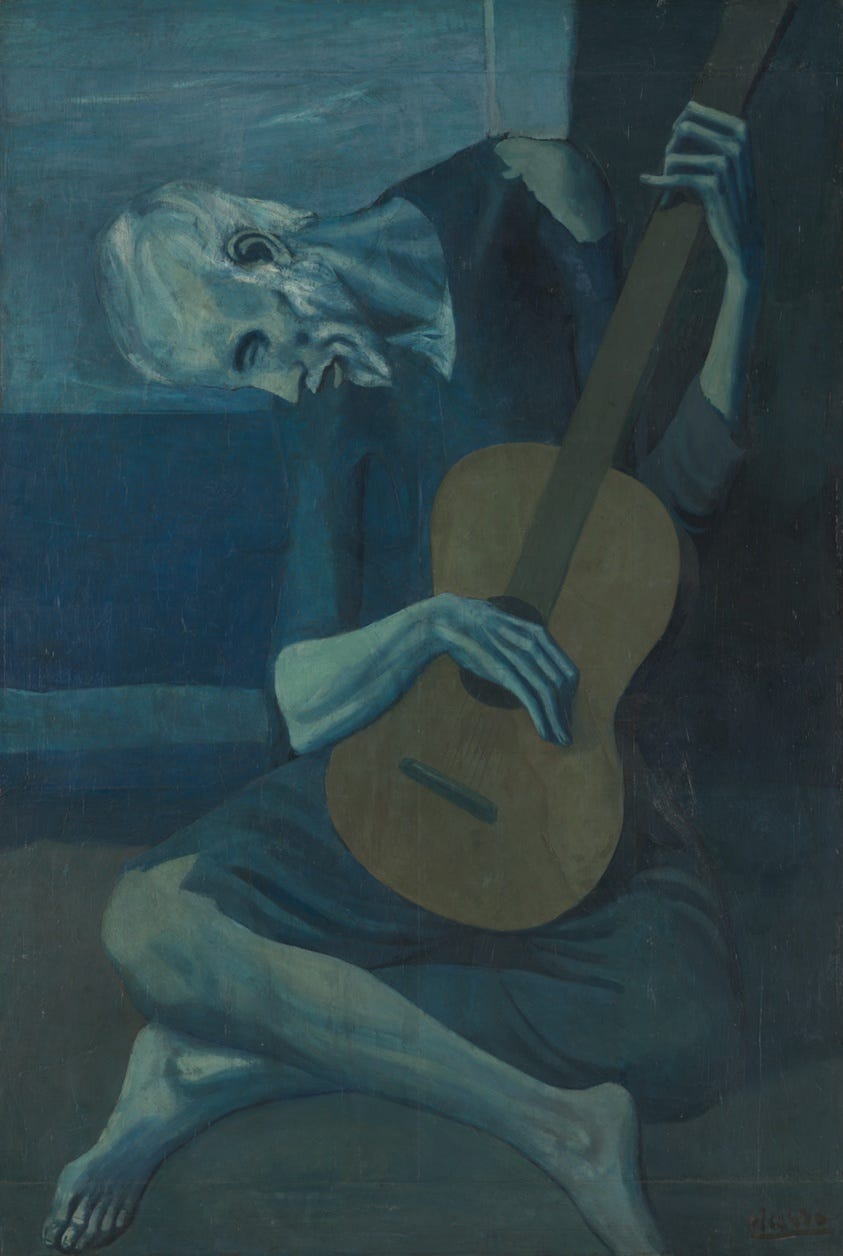
Back in the 70s, the artist David Hockney read a poem by Wallace Stevens written in the 30s that is said to have been based on a painting by Picasso around 1903. The poem was titled The Man with the Blue Guitar.
Let’s start with Hockney. He was inspired by the poem and created a series of etchings which he titled The Blue Guitar. The accompanying book spelled out his two muses right on the cover: The Blue Guitar, Etchings by David Hockney, Who Was Inspired By Wallace Stevens, Who Was Inspired By Pablo Picasso.
Now Stevens. While he disputed a direct link to Picasso’s painting, it is said he did view it. And a very strong case has been made as to the quiet, even unconscious, effect it had on the 33 cantos of his poem: a conversation between a guitarist and his audience about art and reality and the role of human imagination in making something new out of something existing.
And finally Picasso. He was blue and so was his artistic period. Literally. The Old Guitarist is a painting of an emaciated man hunkered over a guitar. Haunting and powerful in its frailty. You can hear the music.
******
We inherit more than we know and by more routes than we can name — via heritage, family, and a myriad of other channels. Of some, we are conscious. Of others, we are not. And there is a tension between inheritance and invention, between the gratitude for the handoff and the need for originality, to make something of our own.
Often it surfaces as a question — What is my idea and mine alone? And what’s underneath is more than the desire for the freshness of imagination. It’s about ownership. And identity.
So how do you honor what you’ve inherited? How do you transform it, hold on to its tradition, borrow and yet cast away? How do you not imitate?
******
From the Greek poet Kostis Palamas:
Heavy jars full
Of the ashes of their ancestors
******
We are busy wanting something of our own, but identity and originality are never fully ours. The past makes things possible. If we immerse ourselves in heritage, in lineage, in endowment, we find we are constantly brought offerings. They are ours to reshape, and that is our creative duty.
Here’s Wallace Stevens at the beginning of his long poem:
The man bent over his guitar,
A shearsman of sorts. The day was green.
They said, “You have a blue guitar,
You do not play things as they are.”
The man replied, “Things as they are
Are changed upon the blue guitar.”
And they said then, “But play, you must,
A tune beyond us, yet ourselves,
A tune upon the blue guitar
Of things exactly as they are.”
Many believe that you have to create something totally new. I believe that you need to look back at history, art, literature, philosophy, and so on. Immersing yourself in the past gives you a great distance from the present and a new way of seeing what’s in front of you.
We don’t hold our tributes in our hands like broken statues. As artists, we bring them forward, we make them our own with new language and images. Every work of art affirms what has come before it, whether it touches it directly or not.
And every work of art is affirmed by the work around it. Picasso’s painting is different before and after Braque. Jane Austen’s novels are viewed differently in light of Frances Burney and in relation to George Eliot. Influence is spacious.
There is no either / or — originality or derivative. But there is always something that is yours. And yours does not mean ownership, because that moves inspiration into a transaction.
Instead, look for a point like Archimedes, a place on that solid ground from which to move the earth. And then you’ll hear the rumbling.
A hundred million birds fly away.
With a bow to R.E.M., to George Seferis, and to T.S. Eliot.
Photo credit: Pablo Picasso, "The Old Guitarist" (1903). Art Institute of Chicago.
From the bookshelf…
If you’re new since the last essay, People Are Messy is now available, and Biography of Deception is a great companion. One tells it plain. The other tells it plot.
With Christopher Nolan’s The Odyssey capturing all of the headlines, it’s also a good time to pick up In Search of Homer. A fun way to approach the two great Greek epics.
And, as always, the rest of the Modern Odyssey Books catalog is waiting for curious readers.
We are delicately shaped by all that we experience. What a nice insight Maria. I can trace much of what I am/do experiences in the homes of grandparents in Ohio and Minnesota as well as life in Pittsburgh in the 50’s. And those antecedents were shaped by theirs. We are shaped by our experiences which are shaped for us by an unseen hand. Our part is what we choose to do with it.
I love this essay. I find it empowering to understand that each of us is part of a thread of influences, that what we create may have a precedent, even if we're unaware of this. It's like a note is passed from one person to the next across generations.